
Saturday 11 July 2026
Brisbane Convention & Exhibition Centre
Technology and Emotions: Feeling the Future
An Overview
Key Themes
Program
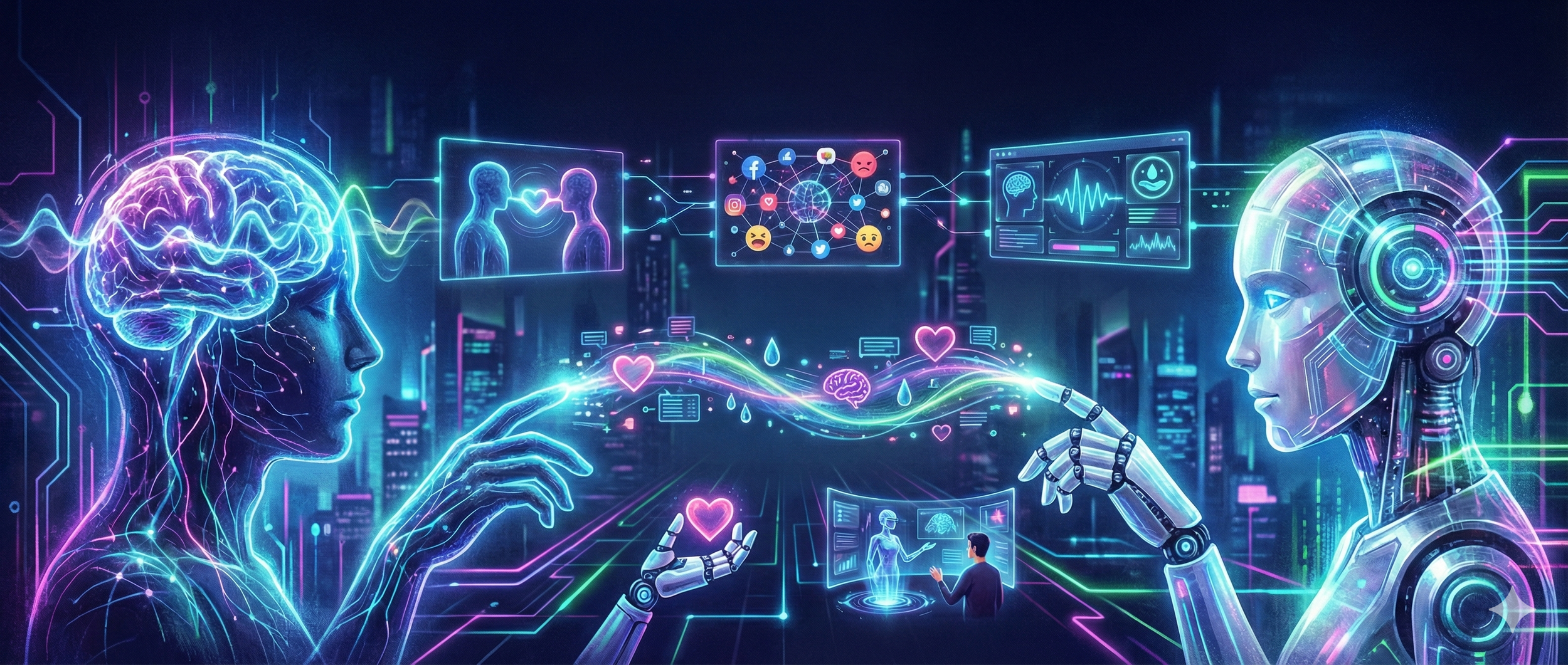
Rapid advances in artificial intelligence, robotics, and digital media are transforming the ways humans express, regulate, and understand emotions. These shifts challenge long-held assumptions about the uniquely social origins of emotion and raise important questions about empathy, communication, authenticity, and trust in technologically mediated contexts. The goal of this pre-conference is to bring together leading scholars who study emotion in the digital age across psychology, neuroscience, human-computer interaction, AI ethics, and related fields to advance theory, share emerging evidence, and spark collaborations.
Human–AI emotional exchange
Are emotions recognised similarly across biological and artificial agents?
Digital empathy
When and how do people experience empathy for virtual or robotic others? Can AI express empathy convincingly?
Emotion in online social environments
How do platforms shape collective affect, belonging, and polarisation?
Ethics and Societal Limitations
Transparency, responsibility, and the future of emotional interaction design.
Emotion regulation through technology
Apps and AI tools for mental health, attention, and social support.
The final program will be posted in May. However, we have confirmed several speakers (see below), who will give 30-min presentations. We also invite shorter presentations (10 minutes) from anyone interested. Please contact the organisers, Eric Vanman (e.vanman@uq.edu.au) or Arvid Kappas (akappas@constructor.university), if you are interested in making a presentation at the pre-conference.
Note: Registration for the pre-conference includes lunch and morning/afternoon refreshments.
Invited Speakers
Confirmed
• Nell Baghaei (University of Queensland). Emotional experience, crying, and affective engagement in virtual and immersive environments
• Marie Boden (University of Queensland). Interaction design, user engagement, and affective experience with interactive systems
• Miao Cheng (Tohoku University). Non-verbal communication, affective computing, body and brain synchrony
• Arvid Kappas (Constructor University). Emotional communication and human–technology interaction
• Guy Laban (Ben-Gurion University of the Negev). Emotional experience, empathy, and interaction design for conversational AI systems
• Monica Perusquía Hernández (Nara Institute of Science and Technology). Affective computing, biosignal-based emotion measurement, and human–computer interaction in technology-mediated affective experience
• Daniel Shank (Missouri University of Science & Technology). Human trust, moral judgment, and affective computing
• Jessica Szczuka (University of Duisburg-Essen). Affective processes in human–AI and human–robot relationships
• Janet Wiles (University of Queensland). Cognitive science perspectives on human and artificial intelligence and emotion
Confirmation Pending
• Roland Goecke (UNSW Canberra). Automatic emotion recognition, multimodal affect sensing, and affective computing
• Juliana Schroeder (University of California, Berkeley). Social judgment, mind perception, and evaluation of artificial agents